Sunday, April 17, 2016

Würzburg, Bavaria - 2 April 2016


The spectacular Marienburg Fortress in Würzburg, Germany
We drove to Bavaria on the Saturday of General Conference to visit Würzburg. The first session of General Conference isn't until 6pm here. We admit that we did not stay up from 10pm to midnight to watch the afternoon session or from 2-4am for the general priesthood session. The internet is a real miracle because it allowed us to watch those two sessions of conference on Sunday morning.

The northern and western part of the German state of Bavaria (Bayern in German) is actually part of the historic territory of the Franks or Franconia. Frankfurt has its name because of the Franks. Würzburg is a lovely city with ancient history. The Marienburg Fortress is a prominent landmark, and the view across the river to the rest of the city is breathtaking. Pictures from the fortress follow.

As usual, Elder and Sister Newman and the two of us met the Jarrards and the Snapps (who replaced Elder and Sister Stevens as records capture specialists for FamilySearch) at the Residenz - the former home of the prince-bishop of Würzburg which was also considered an imperial residence. It was destroyed during a 20 second raid by the British late in the war. They fire-bombed the city and 90% of it burned to the ground. That is sad given the destruction of the historical landmarks, but fortunately much of the artwork, chandeliers and furniture had been moved to storage and were preserved. A massive restoration work was undertaken after the war, but only 17 of the 400+ rooms in the palace were restored. It's still impressive. And the entryway where we started the tour was formerly open for carriages and Napoleon's was so massive that the little general got stuck in the doorway.

First a Few Outside Pictures of the Residenz

Actually, we couldn't take pictures inside except surreptitiously. It's like that in a lot of museums here. Or, you have to pay an extra couple of Euros to take pictures.
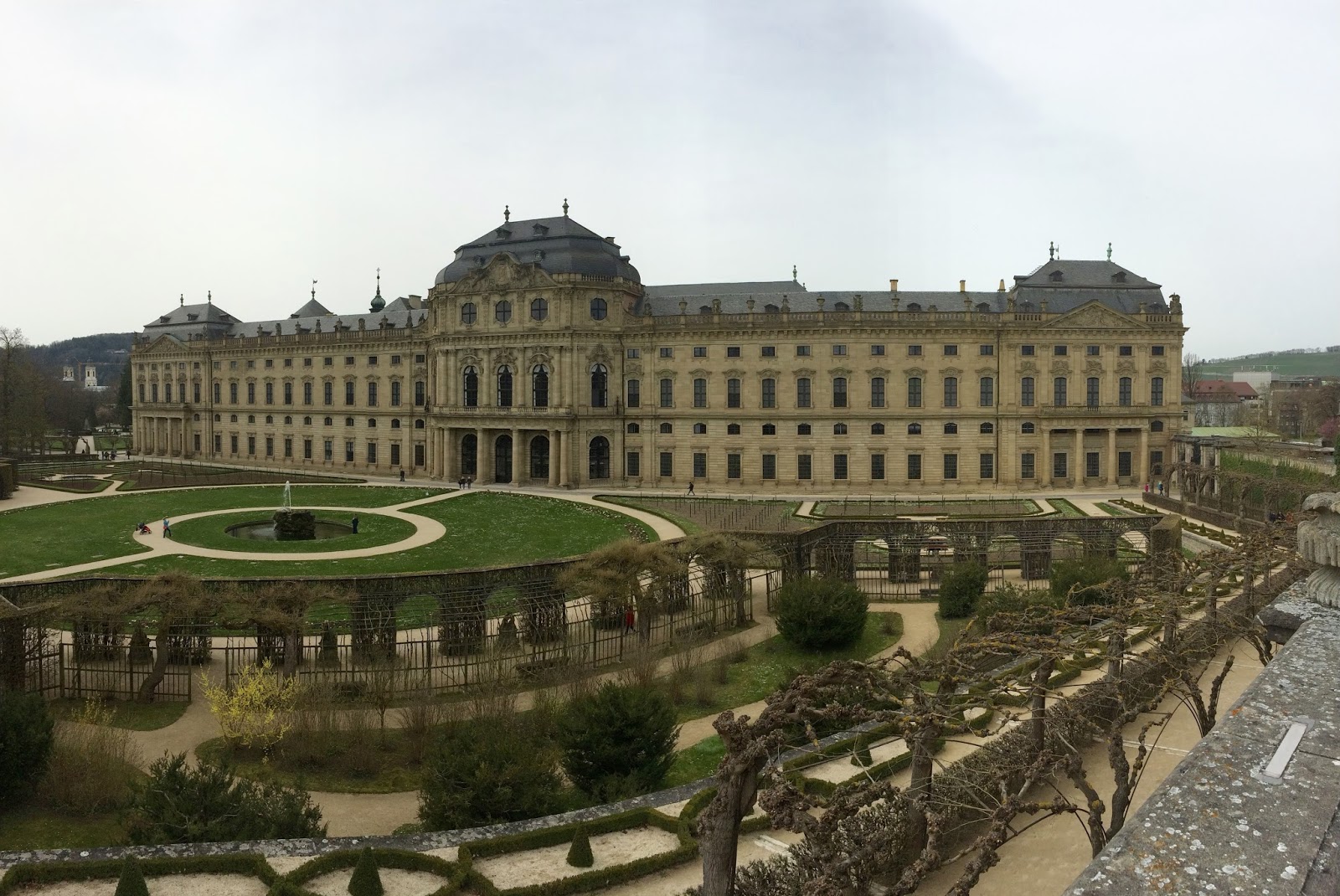
Enormous gray building is the palace - took this from across the river at Marienburg Fortress
Snapps and Newmans with us in front of the palace. The Jarrards were our photographers. The fountain behind us actually survived the bombing

A sculpture

A writer

A philosopher

The light wasn't good for the front of the statue which is facing west

South side from the formal French garden

Too much clipping required. If you look carefully, you will notice that there is a statue at the base of the tree trunk

Not sure what this represents, but it is a popular spot for wedding photos.
Italian Gardens to the east

And a little child shall lead them
There were multiple wedding parties. Great place for pictures.
The part of the palace that is prominent in the center of the east wall contains the imperial throne room.

The roses were just coming up. We want to come back when they are bloom.

Lots of arches and walkways

The trees along this walkway have been "trained" to form an arch

There were a few freshly planted spring flowers.
Great view of a domed church from the garden wall.
Ornate gate to the garden

We liked the statuary along the garden wall

Ornate gate on the north end of the Italian garden


A Few Interior Shots and a Video of the Baroque Chapel

Ceiling of the grand staircase and entryway. The ceiling survived the war because an American lieutenant was an art historian and directed the construction of a temporary roof to protect the frescos during the winter of 1945.
Chapel is contained entirely within the palace walls.

Lunch at the Residenz

It was a beautiful day as the sun broke through. We stayed at the Residenz and had a nice lunch at the restaurant on the property. We sat outside on a patio overlooking the French garden. We got pictures of our friends except for our dear friends the Jarrards. They were sitting by us at the table and a picture was more challenging.
Elder and Sister Snapp (Illinois)

Elder and Sister Mumm (Idaho)

Elder and Sister Newman (Utah)
Marienburg Fortress

Starting about 1000 AD, the Celts built a fortification on the site. So, the fortress is ancient. The current structure (reconstructed after the bombing of World War II) was built in the 16th to the 18th centuries. It saw a lot of action over the centuries. The prominence of the site means that the view from there is spectacular.

Fortress on a mountaintop

One entrance to the fortress

A gate in the outer wall of the fortress

Tunnel opening

Interior wall of fortress and dry moat

Looking over the wall across a small valley

View of the inner keep from a corner
We want to visit this church on the hillside across from the fortress
Long view from the fortress wall

Residenz is the large gray building in the upper center right


City of churches

Close up of Residenz


Sunday, March 13, 2016

Wetzlar, 20 February 2016


Our last Saturday with Elder and Sister Stevens in Wetzlar
Germany is full of quaint cities. It is part of the culture to preserve the past. The most expensive places to live are generally in the "old city" where the houses are several hundred years old and the streets are narrow and often closed to vehicles. It's a little jarring to walk down a narrow cobblestone street lined with 15th century fachwerk houses and see H&M or some other chain store operating in the first level of an old building. In some cities, they have gone to great lengths to preserve the facade of a building that is ancient, but when you look in the back it has been converted to a modern building. I have been told that Germans really hate this. It smacks of movie set.

We stumbled into an organ concert in the church. It was meant to be a musical "Andacht" or devotional, and they passed out hymnals for a single hymn. A man sitting a couple of rows ahead of us sang with a beautiful deep baritone voice. He was an old man, as were all of the congregants. It is not "cool" in Germany to be religious, and young people (except in the church) have little use for churches or worship. They are good honorable polite people, but the second world war and the humiliating defeat with its attendant suffering and the guilt for the holocaust left a spiritual hole in the German psyche - okay, I admit this is just speculation on my part.

Other than the visit to the church and the organ recital and a quick stop in the Saturday market to look at produce and buy some bread and cheese, we did little in Wetzlar. We enjoyed visiting with our friends and had a nice lunch at an Italian restaurant. We talked to people we met about the church and handed out (as a group) a pass along card or two. We will miss Elder and Sister Stevens.

The exterior of the church was never completed. You can see the unfinished front over the market canopies.
Richly colored stained glass

The pews are old and narrow, but they are nicely painted. And the heat was on in the church. That's the first time we've been in a Catholic or Protestant church that the interior was not like a refrigerator. It was still cold.
Shops are only open until about 2pm on Saturday

It was wet and dreary - typical German weather this time of year.

We keep marveling that these crooked houses are still standing after 400 years or more.

It's leaning, but it is solid.


This house, connected to others, is right on the river.

This stretch along the river is beautiful. It will be gorgeous when the trees are green.

From a bridge over the river.
Had to throw in some pictures of sculpture in town.

The title of this one is "Blau Miau" or "Blue Meeow" but it rhymes in German.
Had to throw in this interior of a shop that my brother Brad would love - all kinds of analog stereo equipment -- prices were steep.

Monday, February 15, 2016

Seligenstadt and the week ending Feb 13

Hand painted goose eggshell from Seligenstadt Ostereier Markt
We had a full week in the office this week. As we continue to work issues, things are in better order all the time. We are learning so that we have less rework, and that has made life in the office a lot more pleasant. And we have been able to tackle some improvements and corrections.

Saturday the 6th we received a letter telling us that we could pick up our "Aufenthaltstitel" at the local "Bürgeramt" in Dornbusch. Our apartment is in a quarter called Eckenheim. Dornbusch is a neighboring section that is about a 15-20 minute walk away. The "Aufenthaltstitel" is called a visa by some missionaries, but it is more accurately a residence permit. It is a card we carry that says that we have the legal right to live in Germany until November 25, 2017. Our mission ends in August that year, so we are now legal for the length of our mission. And with this permit we could apply for a German driver's license. You can drive on a U. S. license for 6 months from the date of your arrival. Our 6 months will be up March 25, so we were becoming a little anxious to get the process underway.

We left the office Wednesday with all of the paperwork we thought we would need, but when we got to the office for automobiles and licenses, the lady at the desk asked for a "Sehtest" -- a vision exam. So, Thursday afternoon we went to a local optician. Birgitte passed Jeff, but Janet failed without her glasses which she didn't have with her.

Friday morning we made another run at the vision test, this time with Janet's glasses in hand. She passed with flying colors. The optician really wanted to sell Jeff some new glasses and contacts. She kept telling him that his vision will only get worse and that he can forestall that with the wonderful German glasses and contacts they have available. We noticed that all of their material was labeled Bausch and Lomb, but we suppose that if you buy it here it is naturally better.

We drove back to the Bürgeramt Rund um Autos and got our numbered slip for the wait (short). This time the clerk didn't ask for the "Sehtest," so we decided not to offer the results unless asked for them. They asked in the back, so the first clerk did us a favor and spared us the wait. The office was extremely efficient. This isn't like the DMV in the U.S. The people know what they are doing and do it quickly. After we provided the necessary documents and all was in order, the clerk handed us a plastic card and instructed us to go pay at the "Automat" in the front of the building. You walk to the front, put the card in the machine, and it shows you what you owe. Then you feed in the appropriate amount of cash (€ 35 or about $40 currently - each), and you get a receipt that you take back to the clerk. We should get a letter in the mail in about 4 weeks telling us to come pick up our German driver's license. That part isn't very efficient. Why they can't just mail the license to you we don't know.

We were asked by the zone leaders to present a 'Thema' during their zone training. What a treat for us to be with and observe these young missionaries in the Frankfurt Zone. Because of the driver's license run, we were a little late to the meeting, but we loved hearing them teach each other in both English and German. Our presentation was about how they could serve the members better. Janet suggested that we ask Brad for his input, and he responded with a great letter containing his top 10 ideas, and we read it verbatim during our presentation. Thanks, Brad.

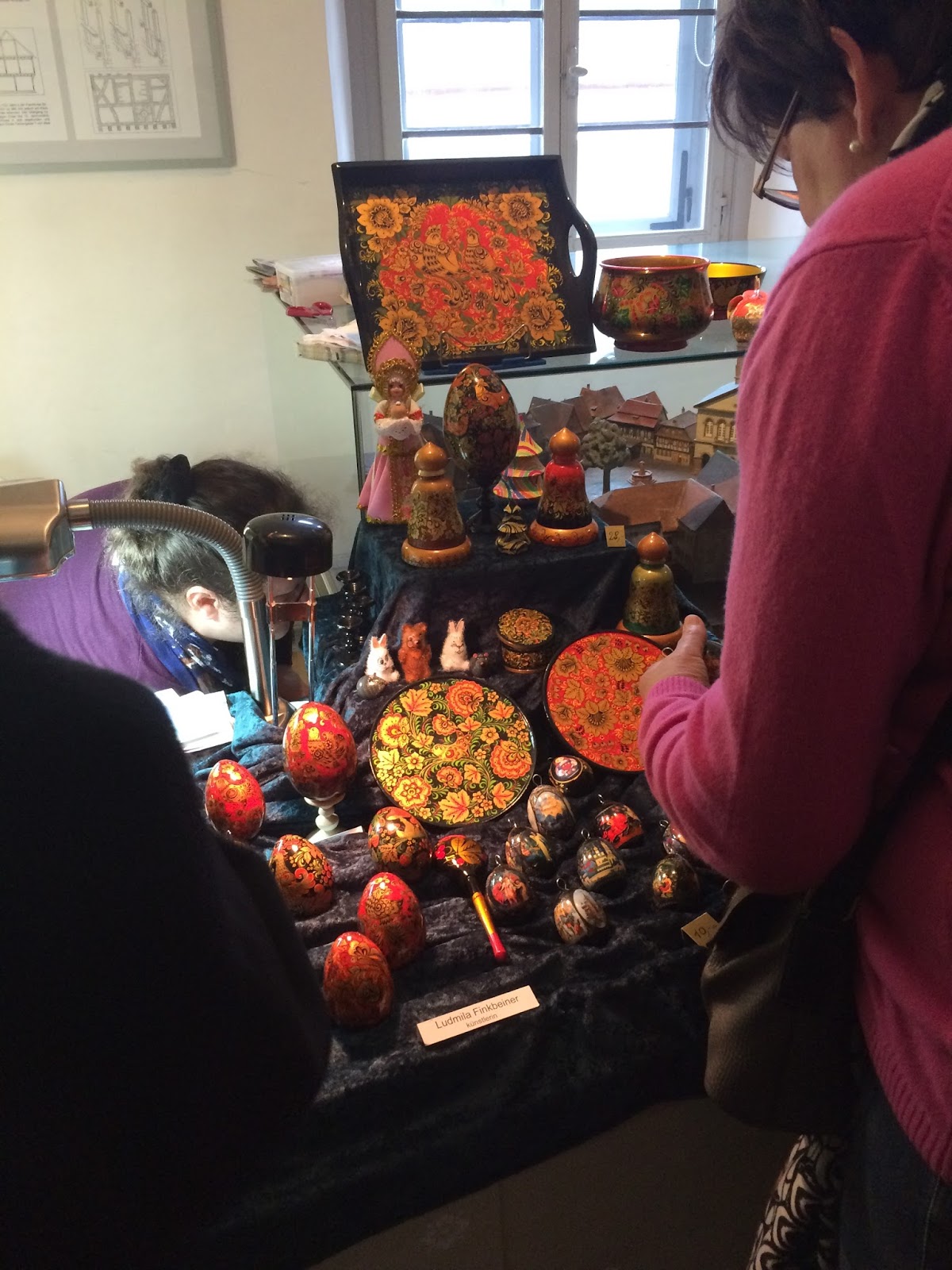
Saturday is our preparation day, so we shop for groceries, do laundry, and try to get in something fun. This week we visited Seligenstadt. It is a very old city on the Main River about 40 minutes from our apartment. The center of the city is all narrow cobblestone streets and alleyways lined with 15th and 16th century fachwerk houses. The church dates from the 800's. There is a former Benedictine monastery that has become a museum. This past weekend, the monastery hosted the first Easter Egg Market of the season. This European Easter Egg market is a showcase for a peculiar form of folk art and there were 50 or so artisans from various places around Germany and from other countries. Jeff had seen enough eggs after about 15 minutes, but he gamely carried on. Janet looked at every single egg (hundreds, at least). Most were real egg shells, but some were made of stone, wood, ceramics, or other materials. Many were really beautiful. The one pictured at the top was one of Janet's prizes. Happy Valentines Day!
Saturdays are market days in Germany. People just love to shop for fruit, vegetables, meat, cheese and bread outdoors.

Loved this old sign -- Riesen means Giants in German

Every German village has a Rathaus or town hall. This one is 500 years old and still functioning.

A damp day near the city center

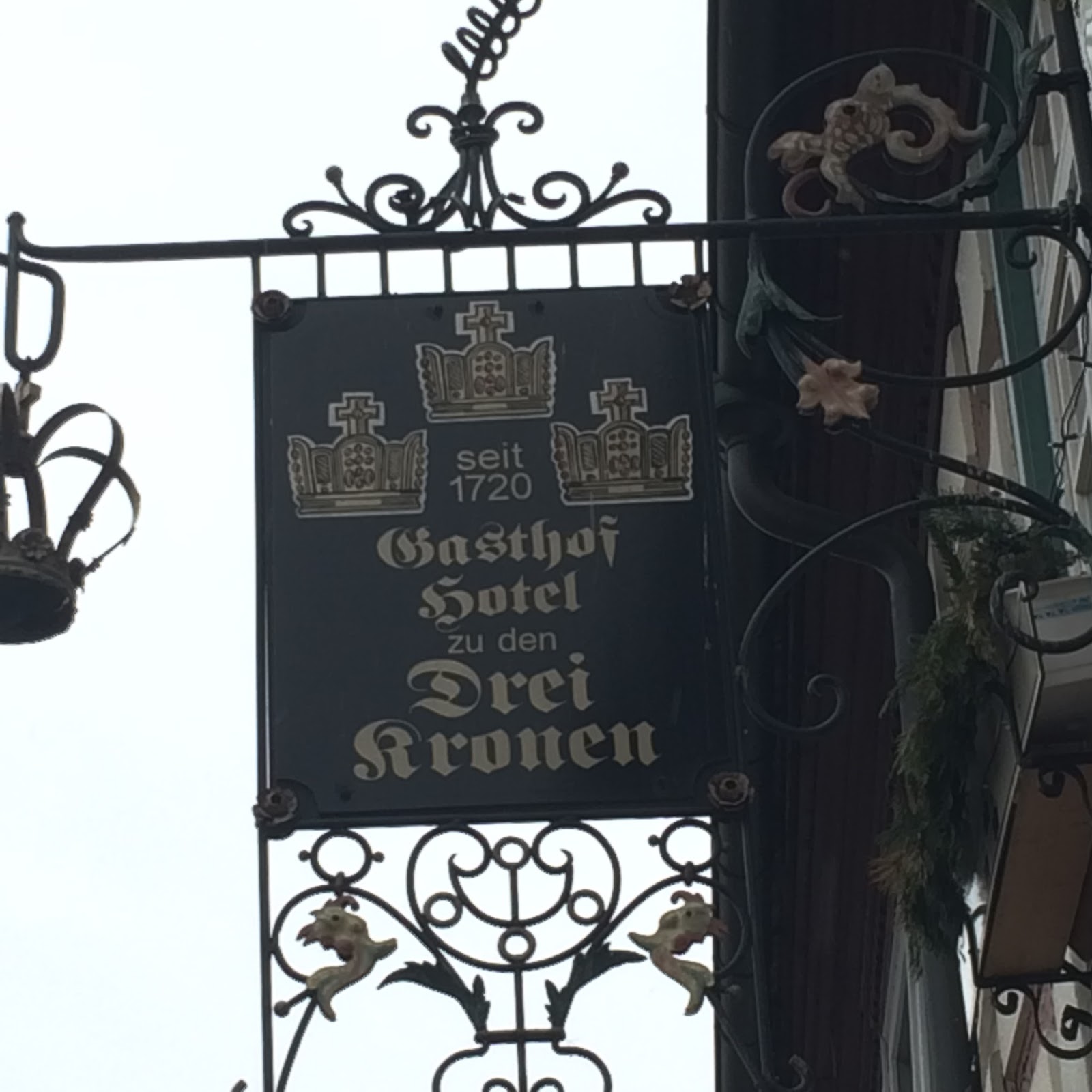
The Three Crowns hotel has been here since 1720

Crowds headed to the market for potatoes at 11am

These 500 year old homes are in great condition

Evidently the exposed timber construction is durable
'

The bells chime 12 o'clock and the Easter Egg Market opens. You have to pay €3 each for entry so that you can then buy things. Jeff has never thought highly of paying admission to an event that is essentially an opportunity for shopping.

A little entertainment. This lady was upset that "rude Americans" kept taking her picture (we were discreet, so it wasn't us, but if you wear that hat, you are asking to be photographed, aren't you?

The hallways of the former monastery were packed

St. Benedict, we presume


Greeter at the museum entrance

Janet's favorite acquisition

A goose egg with clay attached
Most of the museum exhibits were tucked away, but check out this pewter set.
 Next door to the former monastery is a church that was founded around 800. The Roman Catholic church is dedicated to Marcellinus and Petrus, two Christian martyrs during the last round of persecutions in Rome in 304 AD. The building of the church supposedly brought their bones to Seligenstadt in 828 and they reside in a gold and silver shrine under the main altar. The monastery adjacent to the church was secularized in 1803, but the church continued as the parish church for Seligenstadt Catholics.


The church towers visible between narrow gap in houses
Lot's of buildings built of red sandstone. Not sure how they survive the ages in this damp climate.
Church is lined with statues of martyrs. This is the apostle Peter holding the keys. Others of the original apostles were depicted holding the instruments of their martyrdom - a saw, a sword, a club, etc.

This was a great little picturesque village. The people were friendly and welcoming. We ran into some church members who are in Wiesbaden with the military, a young family with 3 or 4 children. We talked to a Texan and some other folks from the U. S. These markets seem to draw Americans and other visitors.

We had lunch at a great Italian restaurant in a building dating back to 1744. The company was great.
Janet's meal - three kinds of pasta

Jeff's tortellino


Pewter symbols for the WC so you don't get confused

Now if you are a kid, these might not be that straightforward
A traditional mailbox

A mailbox with a little pizzazz


Thursday, February 4, 2016

A Couple of Remarkable Experiences

Cover from new Church self-reliance program
The church has begun introducing a program to help people become self-reliant. This is being introduced world-wide. We have welfare services missionaries here in Frankfurt who are support this program in Europe. We were listening to a presentation on this program at church last Sunday, and at one point, there was a short video from President Uchtdorf of the 1st Presidency. As we listened to President Uchtdorf, Elder Kirk received a remarkable spiritual witness that this the the vehicle to prepare all latter day saints to become a Zion people -- one heart, one mind, and no poor among them. The Lord says in Doctrine and Covenants 104:15-16

15 And it is my purpose to provide for my saints, for all things are mine.

16 But it must needs be done in mine own way; and behold this is the way that I, the Lord, have decreed to provide for my saints, that the poor shall be exalted, in that the rich are made low.

We came away inspired. There is so much poverty in the world, including among the members of the church. This material teaches men how to fish and then encourages all members to help one another achieve self-reliance. The materials and information are available online at Self Reliance Services.

The second thing that happened is that Elder Kirk and Elder Newman were called to administer to a young man from Ukraine who now lives in Norway but is here with his mother seeking treatment for a genetic disorder that has completely destroyed his bone marrow. He receives a blood transfusion weekly to stay alive, but the repeated transfusions have resulted in a dangerous accumulation of iron that is wreaking havoc with his internal organs. They came here seeking a bone marrow transplant because there was no good genetic match available in Norway. He has been awaiting a transplant for 3 1/2 years. They pray and have faith, and he wanted a blessing. She is a convert and he was born in the church and baptized at age 10. He is now 18, and they feel it is a blessing that he has lived this long, especially since his marrow quit producing red cells.

As we administered to him, we promised him through the power of the priesthood that he has a mission and purpose in life and that he would live to complete that mission as he exercises faith and trust in God. There was a sweet spirit present for all of us.

We are so blessed to be here and have this opportunity to serve and love people.